
Getting pursued by his mother to join an after school activity, senior Gavin Wu joins the robotics team, later becoming one of his main interests in high school of all four years.
“It was seen as a fun after school activity where we could apply ourselves and learn how to create things that move, and work with our code and our building abilities,” Wu said. “I stuck with it because I really liked being able to imagine something and then create it with my own ability with parts and code and bring it to life.”
Robotics goes past the simple thought of building robots, going from brainstorming to designing to assembling the design. The robotics team also goes to competitions and competes against other schools. The mixture of coding, designing and electrical components.
“Robotics is a very general term that encompasses all the processes that go into it,” Wu said. “What a lot of people don’t realize is that it’s really made up of a lot of smaller, specialized problems that all come together for the robot to work. There’s Computer-aided (CAD) design, machining physical parts, coding autonomous actions, and wiring electrical components, and each area requires different skills.”
Wu’s role in robotics is that he leads most of the mechanical design choices. Wu designs the look of the robot piece by piece so that it could come to life. He also does a lot of the machining and assembly of the robot.
“The machining is fun, but sometimes it’s a little scary [be]cause the tools are expensive,” Wu said. “There’s been some times where I put in a tool, and I programmed it wrong, and it shattered itself, but you learn your lesson.”
The robotics team consists of 18 people, much lower than the amount of people that are typically on a robotics team.
“I think a typical team is 30+,” Wu said. “It’s a lot of different moving parts that go into building a robot, so it’s difficult to do with a smaller team, [but] it’s doable. You’re obviously at a very big disadvantage. It’s very thin in all aspects, which is why we weren’t on time with a lot of stuff this year, but hopefully next year that gets better.”
For the competitions, every year the game changes. Last year it was a pick and place while this year was a shooting game. The season starts during January and the first competition is around March. Teams design and build a robot depending on the game.
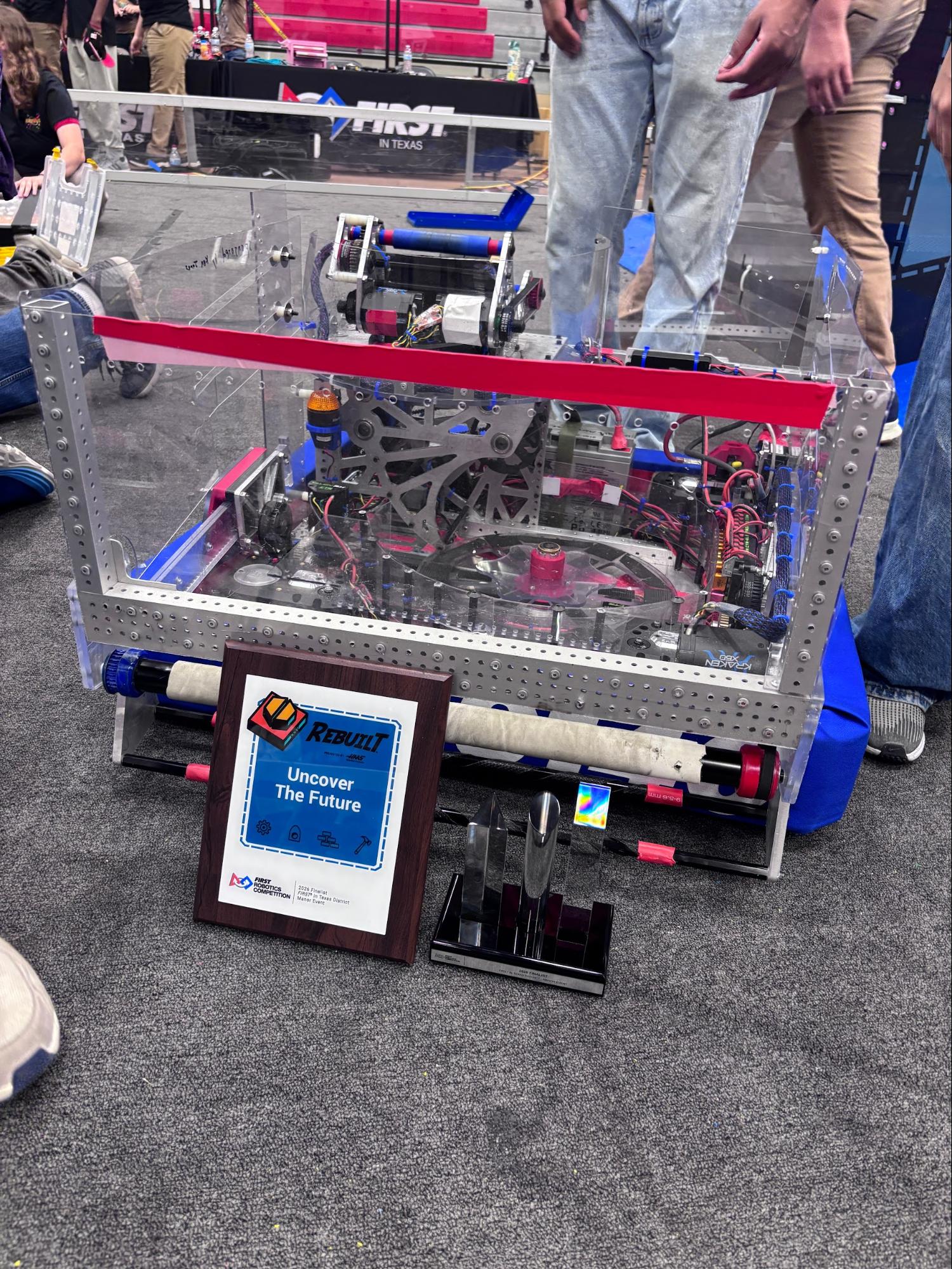
Having a new challenge each year makes the engineering aspect a lot more interesting, because your robot has to meet new constraints and do new things,” Wu said. “The robots from year to year look very different. That also means that in the off season, we have to learn to build as many different mechanisms as possible with high quality, so that when the time comes and a competition calls for it, we can execute.”
The first competition was the regional FIT San Antonio Event. This was one of two competitions the robotics team needed to perform well to qualify for participation in the state championship. At this competition, their whole robot broke down completely.
“At a certain point, every subsystem from the intake to the turret had to be ripped off the robot because it just wasn’t working,” Wu said. “We were all a bit sad after that. We were worried we wouldn’t even qualify for the state championship. But it was very motivating, because we realized we need to put in more hours than we were before, [be]cause we’re a small team. We have to compensate. That second rebuild is where I put in the most hours, and I definitely struggled to get it done, [be]cause there’s just so much stuff to do.”
To get their robot back up for the next competition, Wu put in 80 hours that week after the first regional. Cramming the work of six weeks into two.
“It’s hard, especially [be]cause we have a small team,” Wu said. “I remember when I was doing the 3D modeling, there were times where it was just me and someone else doing the entire blueprint of the robot, which is something that usually takes a team of people. The whole purpose of drawing is that you want a blueprint to make. If you make a good blueprint, then someone should be able to look at it and just make the robot from that. That’s the goal, so if you do that really well, then hopefully assembly comes smoothly, but of course that’s never the case.”
Putting in all of the hours comes at a cost. Although it was spring break, Wu’s grades slipped.
“The unfortunate truth about robotics in school is if you really want to dedicate yourself to this robotics thing, your grades probably are gonna drop a little bit, but you can keep it up,” Wu said. “I think the only reason I was able to put in so many hours [be]cause it was during spring break and also school was winding down at the same time. It does get rough sometimes, especially if you’re a junior or sophomore, but we understand, and we accommodate for that.”
Their second small regional competition was the regional FIT Manor event, the second of two events they needed to do well to qualify for the state competition. After the performance at the first event, they needed to perform extremely well at this one. In the end, they won the Excellence in Engineering Award sponsored by Littelfuse. This award congratulates a well-designed robot that incorporates systems smoothly. They won this because they explained every improvement from the first version of the robot.
“We ended up finishing the robot on the floor of the gym at the competition because there were some final touches that we hadn’t done yet,” Wu said. “That was really stressful, but the reason we held through it is because we had designed a very ambitious robot that we were confident would work well when it was finished. And so as the competition went on we kept getting better and better. We won match after match until we eventually became finalists.”
The final competition was the Texas District Championship, a statewide competition with 90 teams. The level and quality at this competition was extremely high, competing against teams like Vandergrift High School, Westwood High School, West Lake High School, and Robotauts, sponsored by National Aeronautics and Space Administration (NASA.)
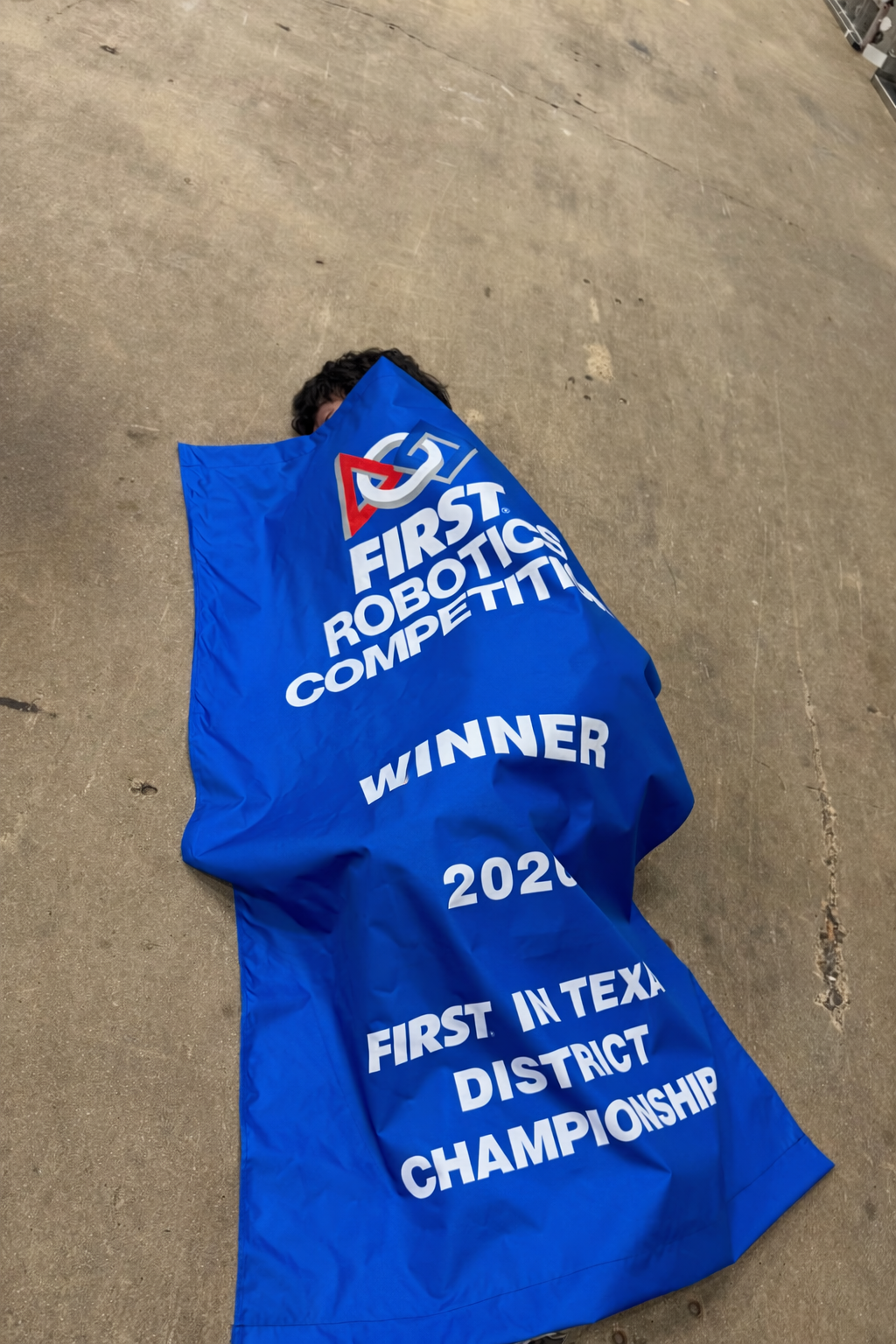
“It was so rewarding,” Wu said. “All of us work[ed so hard for so many hours. Winning’s always fun. That’s why we spend all the late nights doing this stuff, because we want to see the robot compete against the best teams that maybe have more people or history than us. [The 80 hours] ended up paying off [be]cause leading up after that first competition, we got better and better until we won the district state championship.”
The robots team will continue their team for these next oncoming school years.
“One thing I really want going forward is that we want it to be clear, you don’t have to be a typical robotics kid,” Wu said. “You don’t even really have to be an engineering student. If you like working on things that move like cars, making and designing parts, watching stuff get machined, or whatever it may be you should join. I had a really fun time, even if it was challenging. But that’s the fun part, you work a lot and you learn a lot and you make memories with the friends you compete with.”