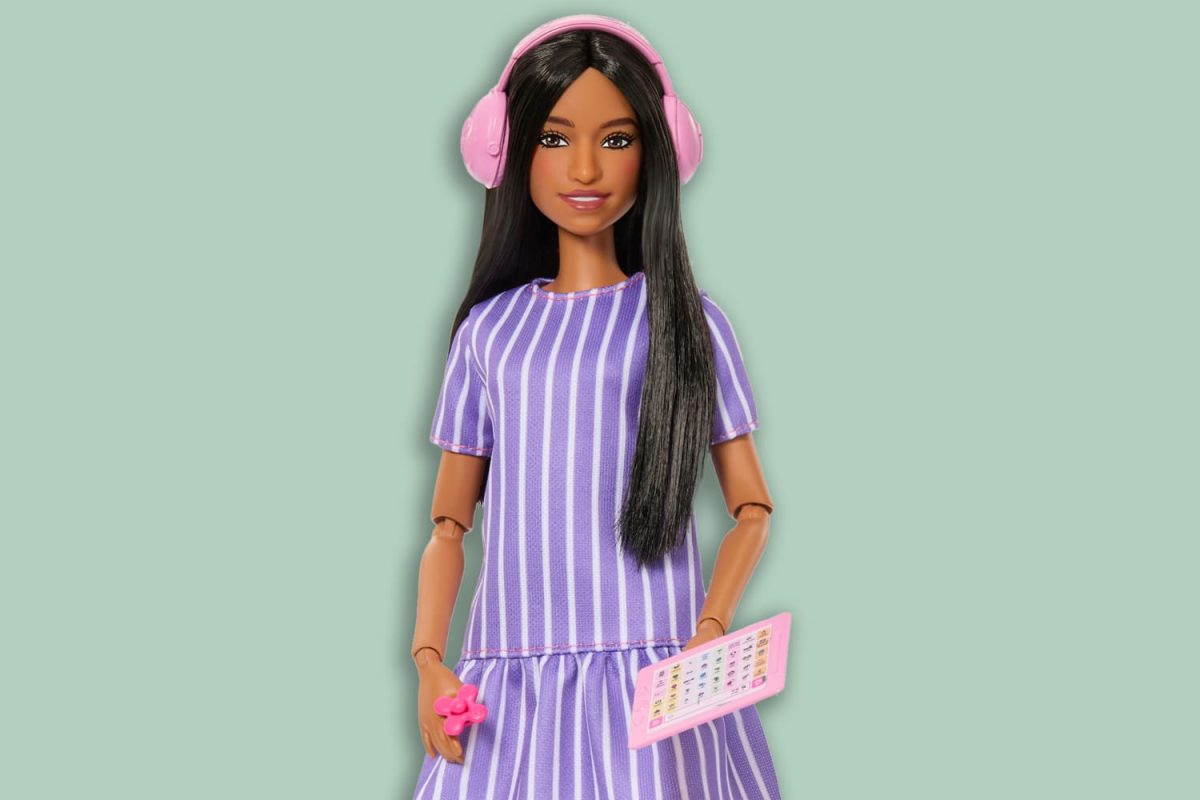
Many are celebrating the release of Mattel’s very first Autism Barbie doll.
The concept is good on paper. A doll that represents many experiences of an autistic person seems like a win for the autism community. In fact, the doll was made with guidance by the Autistic Self Advocacy Network.
And the execution is solid. It has outstanding wrist and elbow articulation to simulate stimming, shifted eyes to avoid eye contact and sensory-sensitive fashion that would be accurate to some people with ASD. The accessories, too, reflect the experience of some autistic people, as the doll has a fidget spinner, headphones and a tablet that displays augmentative and alternative communication apps.
These do reflect a lot of common experiences for some autistic people, even down to the high support needs side of the spectrum. It seems like a great representation of autistic people.
Children on the spectrum would probably feel seen by this doll, especially children with high support needs who are more visibly autistic, such as the doll is. High support needs autism is somewhat underrepresented in pop culture, so such a popular doll brand making something that can represent them is a wonderful thing.
However, there may be an issue here.
Now, there’s nothing wrong with the representation the doll has. It actually is fairly accurate on that front. The problem lies with the influence Mattel has, and the views people will have.
Autistic people already face issues with people doubting their condition because of people misunderstanding what autism is. For example, a neurotypical person with an autistic relative may see that relative as the only idea of autism that they have.
This phenomena is exacerbated with pop culture. Sheldon Cooper from The Big Bang Theory, although not intentionally written to be autistic, is such a wildly popular character that people associate with autism that the majority of people will only see autistic people as Sheldon: socially clueless jerks.
Barbie is one of the largest doll brands in the world, so having an autistic Barbie doll with these little representations all add up to create yet another rigid view of autism that a lot of people will see as the only thing autistic people can be.
This is no fault on Mattel’s part. The representation is good, but its societal impact will probably lead to more problems than solutions.
But, despite everything, as long as there’s a new generation of children who grow up feeling like they’re seen by society, like they have a voice, then it could be argued that the doll absolutely succeeds at what it set out to do. It’s bittersweet, in a way. But at least it’s one of the few good representations of autism out there for the world to see.