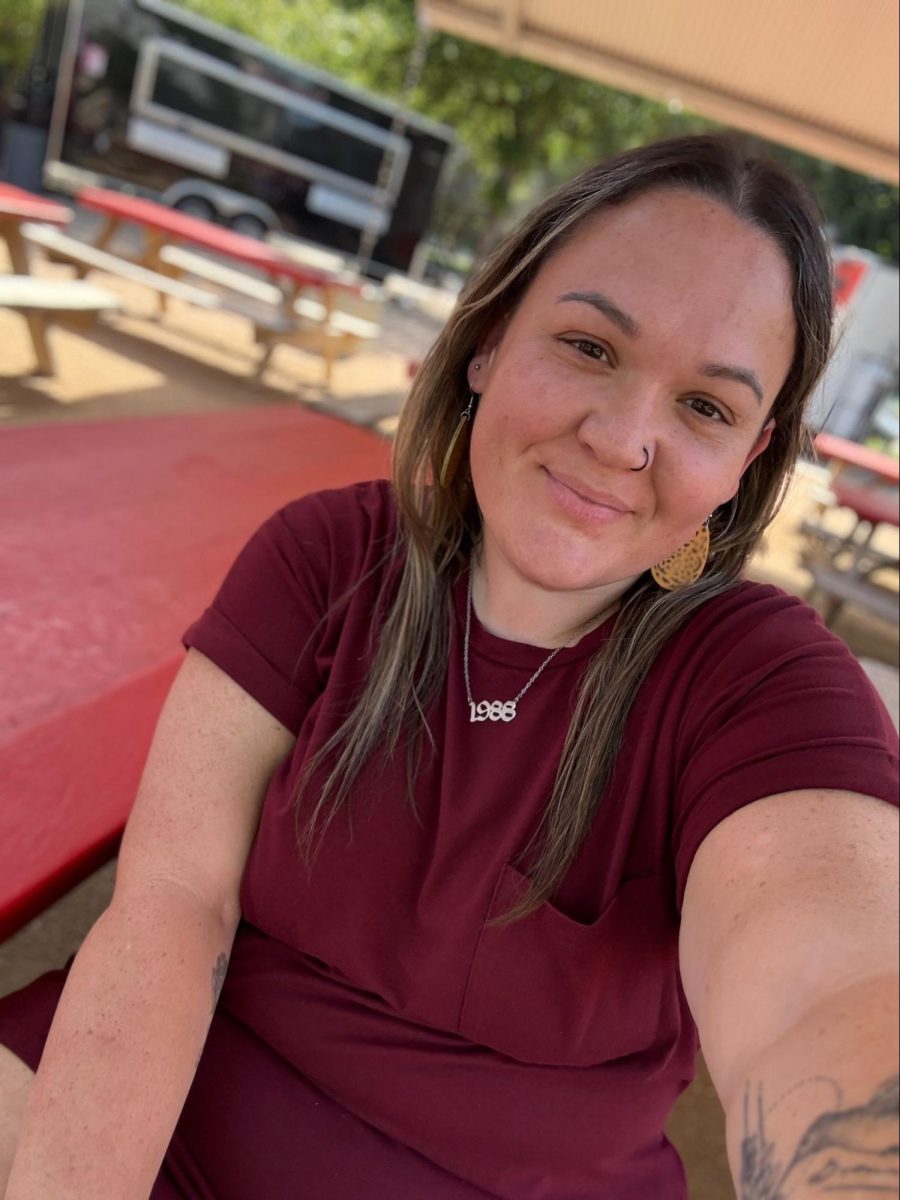
While most teachers rely on their voices to gather attention, the new American Sign Language, ASL, teacher Britni Stephenson lets her hands do the talking. Learning how to teach hearing students for the first time, she is showing her students that silence is not a barrier but the start of a new form of communication.
Since Stephenson is deaf herself, she not only brings a new perspective, but gives her students the chance to learn from someone who lives with the language and culture every day.
“ASL is my primary language for communication and daily life,” Stephenson said. “Because of that, I have a strong connection to the language and culture. I know teaching ASL will come with challenges, but I also believe it will be incredibly rewarding to share my language and identity with new learners.”
Her path to teaching began in deaf education where she worked with students for four years. That experience gave her the knowledge and pushed her to consider teaching hƒearing students.
“I used to live in Austin before moving to San Antonio for job opportunities, and after almost five years there, I decided it was time to return,” Stephenson said. “One of my supervisors suggested I consider teaching ASL at the high school level. At first, I was unsure because it was something new. I had always worked closely with deaf students, but I had never taught hearing students before.”
This means her classroom looks different than most. Instead of hearing lectures, students rely on eye contact, signs, and visual focus to communicate.
“Being deaf will definitely shape the classroom dynamics, but in a positive way,” Stephenson said. “ASL is my first language, so students get the opportunity to learn directly from a native user of the language. Because I communicate visually, students are encouraged to really focus on eye contact and attention, which actually helps create a stronger learning environment. ”
Adjusting to a new teaching environment does not come without worries. For Stephenson, the challenge is not just about lesson plans but about navigating communication styles in a classroom full of students who know little of what she is signing.
“Like any teacher starting something new, I do have a few nerves,” Stephenson said. “This will be my first time teaching hearing students, so I know there will be challenges as we all adjust to each other’s communication styles. At the same time, I see those challenges as opportunities for growth, for both me and my students.”
Students are excited to learn from a new teacher this year and appreciate the opportunity to learn from a deaf teacher.
“She is doing well for her first year,” junior Nathan Mahone said. “She’s really nice and is one of my favorite teachers.This is my second year in ASL. She is teaching us a lot of words that can help us in the future.”
Long before stepping into the classroom, Stephenson worked with families of deaf children as a deaf mentor with the Statewide Outreach Center at the Texas School for the Deaf. A role that she still has, gave her a chance to teach parents how to sign with their children.
“I support hearing families who have deaf children from birth to age five by teaching parents ASL so they can communicate with their kids,” Stephenson said. “Those experiences, both in the classroom and working directly with families, have prepared me for this new opportunity to teach ASL at the high school level.”
Stephenson’s childhood also shaped the teacher she is becoming. Growing up as the only deaf person in her family, she found joy in play, movement and creativity.
“I loved playing outside until dusk, riding my bike around, hanging out with neighborhood friends, and spending time with my cousins at family gatherings and holidays,” Stephenson said. “My parents signed me up for dance classes, ballet, jazz, and tap, for about six years, and in my last year I even tried clogging.”
She believes that learning ASL is more than learning the vocabulary, but about building bridges with communities.
“I want students to know that learning ASL is more than memorizing signs, it’s about connecting with a culture and a community,” Stephenson said. “I’m grateful to be here, and I’m really looking forward to sharing my language, building connections, and growing together this year.”