![In 2013, 10 years after graduating from Columbine High School, Peacock drove by where he used to live in Colorado, stopping by Columbine to take a picture. “My brother lived in a different part of Colorado and we were going through the Denver area on the way,” Peacock said. “I didn't really do much beyond see[ing] the school from the outside.](https://mhstrailblazer.com/wp-content/uploads/2025/12/image3-4-1200x900.png)
On Aug. 16, 1999, David Peacock would begin his first day of high school, like any other freshman. Although the first day of freshman year is exciting, his experience would be a little different. He went to Columbine High School.
Without any social media, the massacre was widely spread throughout the national news, because it was out of the ordinary. At this point, school shootings were a new phenomenon.
“We don’t have cell phones, so I don’t even know why we found out about it while we were at school, but we found out about that day,” Peacock said. “I remember the next day because we knew a lot more about what the shooting was. The administrators were bringing all the students together in a room, everyone’s sitting in the round table and having a conversation together about that shooting because no one can comprehend the idea of a shooting like this happening at a school. Schools are supposed to be safe, but I do know in the back of my head, I’m moving to Colorado.”
The Columbine High School massacre occurred on April 20, 1999, a school shooting where two students murdered 14 people and later the two committed suicide. Although Peacock was not there during that day, he went to Columbine the following school year. Administrators at Columbine High School knew they had to address the tragedy and relieve the tension, so they held the major “Take Back the School Rally.”
“Everyone at Columbine knew all the students were going to be on edge, so they held the pep rally to try and change that nervous energy into excitement and maybe even a little joy. For me, I was nervous because I was moving into a new area and didn’t really know that many people yet.”
Living in Fairfield, California, Peacock knew before the shooting that he was moving states to Colorado over the summer for his dad’s promotion to a higher position in the newly formed Treasury Inspector General for Tax Administration agency (TIGTA) . The job area was in Denver, Colorado, but they lived in Littleton, Colorado – in the district for Peacock to attend Columbine High School.
“Our thought was, this isn’t this is not an area where this normally would happen.” Peacock said. “There’s no way this type of thing happens again. The people who did it aren’t going to do it again because they are no longer around. If anything, this is going to be the safest school in the nation post the shooting. There’s no way that they’ll let this happen again here.”
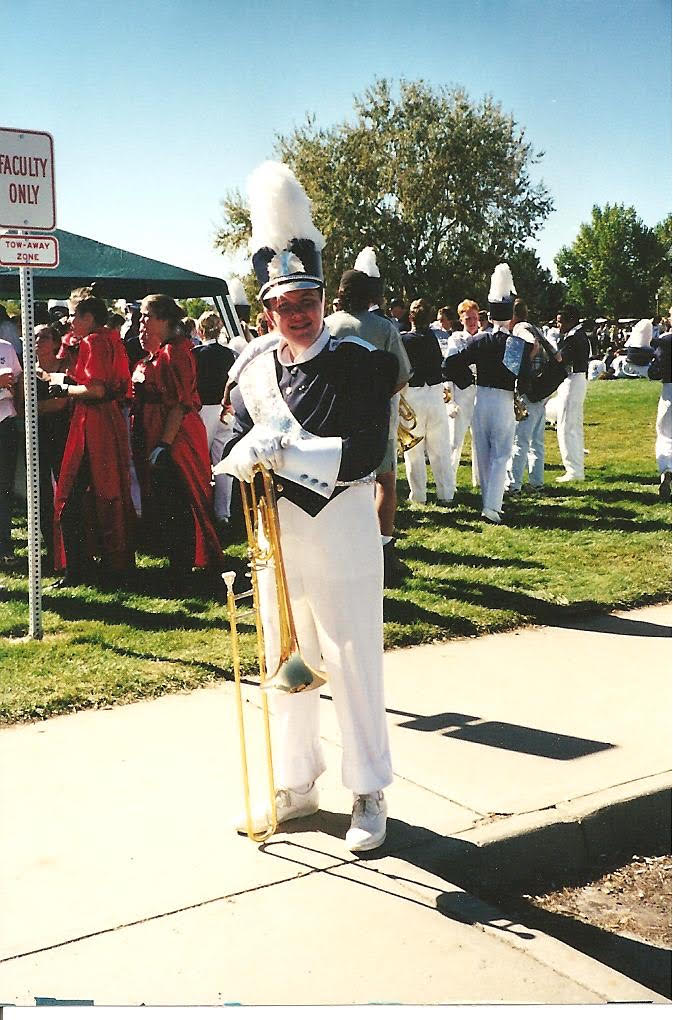
Being a part of the band and competing at competitions, it was common that competition centers would hold a moment of silence for only Columbine High School when they performed through the year of 1999 to 2003. This brought back the memory of those who went through the tragedy, ruining the bright mood of the band right before their performance.
“I fully get why they did it,” Peacock said. “It needed to happen because it’s very awkward, but it led to such a drop in energy before our show. So much of a performance is getting yourself hyped up and keeping up the energy.
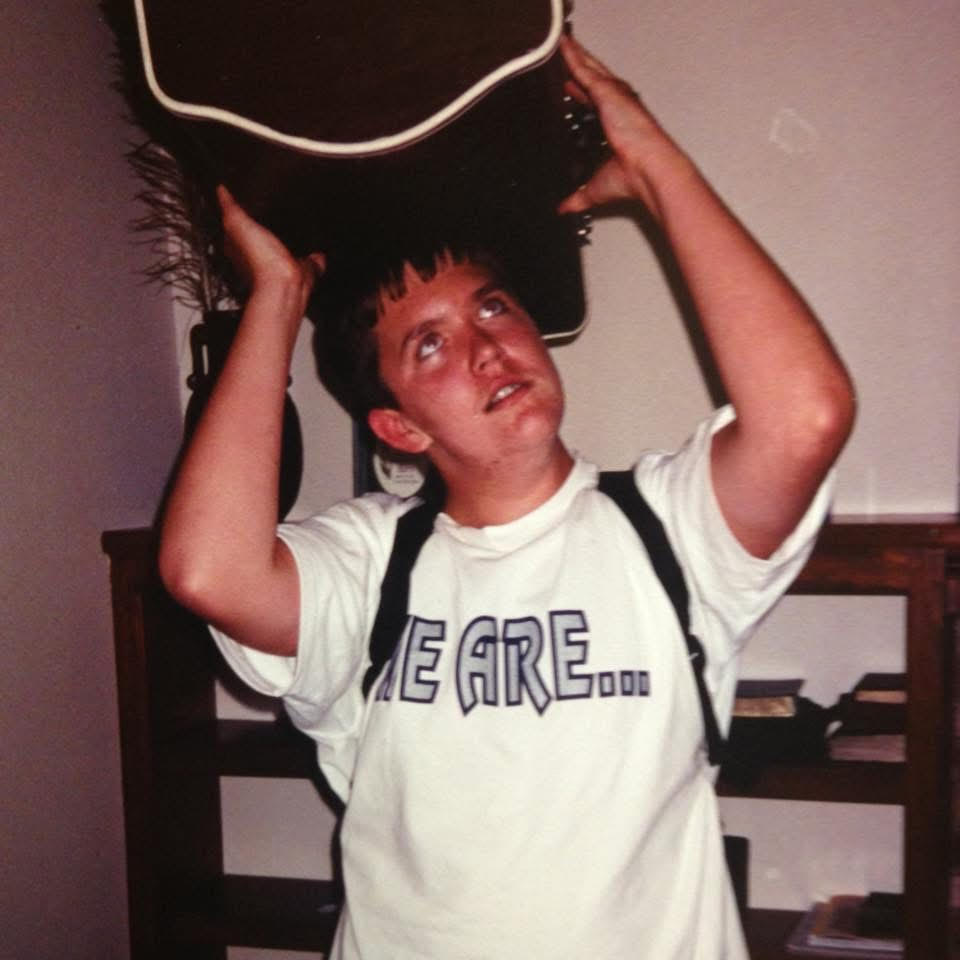
This brought down the whole band and made our performance suffer. Whereas the next year we actually did pretty well, but like that year, it did not go well. That was a weird thing that also happened that year. Our first year we had that going in to kind of try to ease some of the tensions and everything.”
Along with the awkward moment of silence, there were many families or individuals who’d come up to students outside of the building asking them to take a picture. One being Peacock at times when he would be standing in front of the school.
“When I was a freshman or a sophomore there were so many times when someone would drive up with their whole family and ask, “Hey, can you take our picture in front of Columbine High School,” Peacock said. “Something we all all do to some degree. It’s really weird, but people started coming to our school as a tourist stop. To some degree, I’m actually glad with the times that they stopped and it was me and not someone who had actually been there when [the shooting] happened. Unfortunately, people were being asked to do weird things. There were some who were more than willing to do that, but there were a lot of kids who just want[ed] to go back to living a normal life and they couldn’t.”
On May 19, 1999, Star Wars: Episode l – The Phantom Menace came out in theaters. With his interest in movies, Peacock often discussed new movies among his friends, hearing that some students couldn’t watch the film due to the noise of the lasers.
“They had been excited about it,” Peacock said. “Even though it doesn’t have [actual] guns, it has a bunch of laser guns. Even the noise and people shooting at other people, and even though it’s very much sci-fi fantasy and it’s not realistic, there were kids that couldn’t even handle that after going through the shooting. We had a lot of issues like that that happened throughout the year.”
Since the Columbine High School massacre, the school added some safety features, including another unarmed security guard and extra security cameras. The lack of security alterations and continuing an open campus brings controversy to the district.
“It’s similar to after 9/11, all the stuff that they added to security lines and taking off your shoes and stuff like that,” Peacock said. “That was all done, not because it was really going to do a lot to stop things, but because it made people feel safer. It’s called security theater. A lot of the things that we do as a school, I would say are a kind of security theater. I think when we do our shooting drills that’s not really preparing us for a shooting. It’s not even really preparing us as much as fire drills do. It makes sense, but people get very scared and if you don’t know what you can do, you create things to do so that you can feel like you have some control in an uncontrollable situation.”
Attending Columbine, the majority of the teachers who went through the shooting that wanted to leave because of it, stayed until 2002 for all the students who experienced it to graduate.
“I’ve been a teacher, but I don’t know how I’d be able to handle that if there was a mass shooting,” Peacock said. “A lot of teachers stayed because they wanted to be there through at least the freshmen that were there during 1999. I fully support that, that was great.
During the Columbine High School massacre, the majority of deaths occurred in the library. Due to the amount of time and resources that it’d take to rebuild or demolish the library, the library was closed off with lockers causing the library to shift to two large portables. It took two years for a new library to be built.
“My freshman year, you wouldn’t have even known where the library was if you were just walking through it,” Peacock said. “I only knew because people told me where it was. The library itself, they could hide it, so the bigger thing that they needed to do right then wasn’t so much demolish the library because no one was going in there. They needed to first make sure that they had cleaned up everywhere that there was damage from the shooting that kids would actually be walking by.”
At Columbine, all students were aware of the shooting, but it wasn’t talked about much. This was primarily to prevent the tragic subject from crossing the victim’s minds.
“It wasn’t like a taboo subject that you could not say,” Peacock said. “You could discuss it. Some do, some really want to tell them more stories, but a lot of them don’t want to talk about it unless they’re with a very specific group. That would be if they’re meeting with a group that they hadn’t seen in years and they’re the closest that they’ll ever get to therapy. Most people didn’t want to talk about it on a daily basis. Most of it was people talking about how the weird things that they’ve noticed they can’t really get through. A lot of them hadn’t fully even coped with it.”
To take precaution on any threats made on the school, any minor threat the school heard about students wouldn’t have school that day. Those days were called “threat days” amongst students. A time where there was a threat day was when a student met someone online on AOL Instant Messenger (a messaging program, similar to WhatsApp) and the man said he also went to Columbine and he was going to shoot up the school that next day. Turns out, he was a man living in Florida with his parents, nowhere near Columbine.
“It was odd to me because I was suddenly living in a state with so much snow, but they were prepared for that,” Peacock said. “I ended up having so many more days that we missed because of threats. Even when you know that the school is safe and the threats are coming from people outside the area or even state, it is disquieting. When you get back, you can’t fully quiet the voice in the back of your head that it’s not fully safe to be here.”
Sept. 11, 2001, Peacock was in his junior year when he saw on the television about the terrorist attack on the twin towers. With the freshman class of the Columbine High School massacre still attending Columbine, principal Frank DeAngelis refused to let classrooms show the news.
“He was so afraid of that affecting kids and that was something he had to worry about,” Peacock said. “I fully get why he did, but it was very weird because like we were expected to go through our day as though nothing was happening, which was very weird for that day.”
Also in his junior year, Peacock suffered from a back injury in school while playing the piano. Soon, the ambulance came and put him on a stretcher, taking him through the cafeteria during a lunch period and students saw him.
“I’m not saying anyone was super affected because they cared way about me, but for some kids, seeing someone being taken out on a stretcher, because there were still seniors that year that had been there during the shooting,” Peacock said. “It did apparently trigger a couple of people because they saw someone being taken out and that brought them the worst memories that they could possibly have. Things like that were enough to trigger certain kids.”
In Peacock’s senior year, there was a student who wrote on the bathroom stall the date of an AP testing day, the location being the library, and the word “boom” next to it. Due to College Board guidelines, school can’t be cancelled on days for AP testing, so unfortunately school could not be canceled. Even more unfortunate, Peacock tested in the library.
“We were supposed to be taking this test and focusing on the AP test, [but] in the back of our mind, of course, all of us had the theory that it was probably someone who just wanted to get the AP test cancelled,” Peacock said. “There was a small part of me that was like, but what if it’s not? I could not believe that this was the closest thing to one where we know it came from here and yet nothing happened from it.”
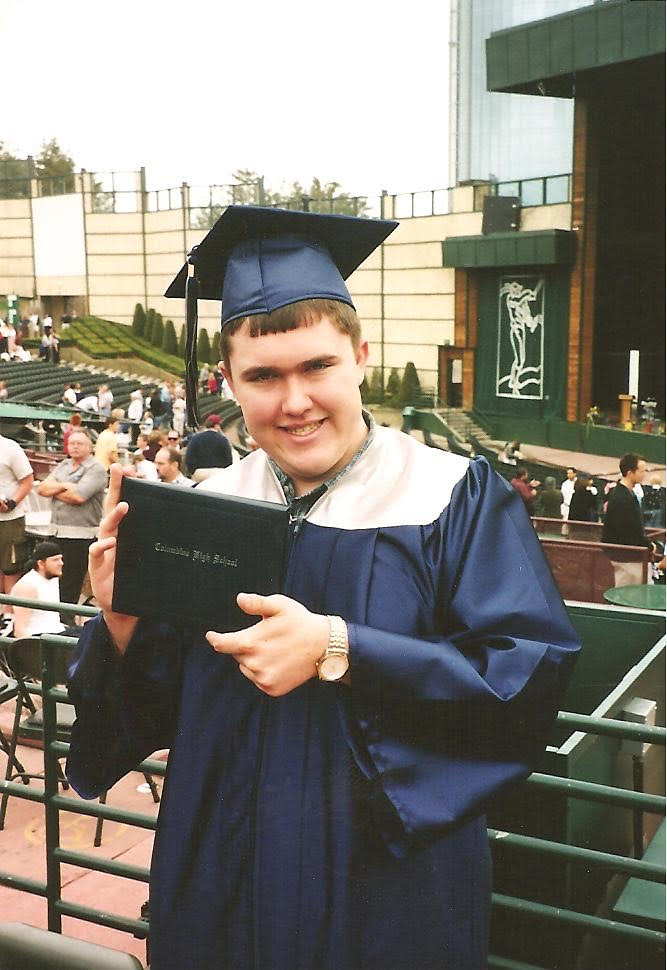
Peacock attended Columbine for the rest of his high school years, graduating with the class of 2003. Discarding the history of his high school, Peacock said he loved his high school experience in general.
“I found myself actually really liking Columbine,” Peacock said. “I found people that I was able to hang out with at times. I enjoyed my classes [and] I enjoyed a lot of my teachers. I think all of that worked really well. I thought the school worked really well for me. I know that there are a lot of people that don’t love Columbine. I’ve had a weirder high school experience than a lot of people have because my school had just gone through a tragedy.”
In the state of Texas, the legal age to own a gun is 18, same as Colorado – controversial amongst those who believe we need the second amendment and those who lose close ones due to gun violence.
“If you look at similar economic countries to ours, most countries don’t have this level of gun violence,” Peacock said. “Our level of gun violence is far too high for a nation that thinks of itself as what the leaders of the freed one. I think that we all act as though they’re more invaders. The tragedy is that most of the time it does end up being that if a gun gets used in a home, you find out that it’s something else. You can see the gun laws and how they’re becoming worse, they’ve gotten way more lenient.”
In most murder tragedies, a lot of people will look at the side that “maybe they had mental health issues.” It’s widely talked about that the two shooters in the Columbine High School massacre had mental health issues.
“I don’t think anyone [who is] shooting up a school is going to be shown to have a completely clear mind at that point, so yes mental health was a part of it,” Peacock said. “I think that sometimes the way you’re raised matters, but even then sometimes that’s probably a contributing factor most of the time. A lot of times you might think, ‘they are teenagers, so it’s a phase’.”
Being a teacher at Round Rock ISD in August of 2018, the district regulated a school shooting training called CRASE training (Civilian Response to Active Shooter Events) on how to respond to an active shooter that consisted of the full day with all of the teachers. At the beginning of the training, they played the call from the Columbine massacre from the librarian to the police. In the call, the librarian isn’t giving descriptive details of what’s happening. This call was used as a bad example of what not to do.
“It felt very judgy,” Peacock said. “I remember in terms of how they were doing it, because they were trying to make the point that we have to be prepared for this, but also, that’s a wrong example. The first [school shooting] where no one was ready for this because none of us actually think that we’re going to be at a school shooting. Most of us have never been in a situation with gunfire – outside of a shooting range. I fully understand the lesson of [to] not follow every single rule exactly how they portrayed, especially when they hadn’t been trained that way.”
Today, schools face many “fake” threats by their students or others, caused by those who think it’s comical and have that type of humor. Over the years making threats to the school has normalized more amongst younger people.
“I think that a lot of times a lot of people aren’t even trying to necessarily think about the long term implications of making those threats,” Peacock said. “It’s not funny and it has to be taken seriously. Every kid who’s committed a school shooting was probably like that until they really did it. I fully understand why people are making those jokes and that they think it’s funny, even if it’s not. It doesn’t fully change the fact that it doesn’t matter because you’re still going to get in huge trouble. It doesn’t change that it’s a massive threat.”
Being a teacher transition today, Peacock experiences these threats – fake or real. Seeing the victims of these tragedies, his opinions are more different than others who think it’s funny.
“I think going to Columbine has changed my view and that I’m more focused on school shootings than some people are, to a certain degree,” Peacock said. “I take it more seriously. I remember that Columbine didn’t really add a lot of the security features that a lot of schools did. I think just growing up knowing that makes me view a lot of the things that we do that we are saying ‘here are all our great security features.’ I kind of feel like a lot of those are not as helpful as we like to pretend that they are.”
School shootings unfortunately occur too often than they are supposed to. There are many school shootings that are not spoken about or don’t get any coverage. For example, Evergreen High School that occurred on Sept. 10, 2025 and Parkland High School on Feb. 14, 2018.
“The weird part now is that that’s not what you all grow up thinking,” Peacock said. “Again, it’s normalized now [and] it’s as bad to say that it’s normalized. I hesitate to bring [Evergreen] up because that is a very charged shooting that I’m saying, but on that same day there was also another school shooting. It was not one of the larger ones, but the fact is it was still someone [who] came to a school with a gun to shoot. You will often hear people say that this is just an unfortunate truth of our reality now.”