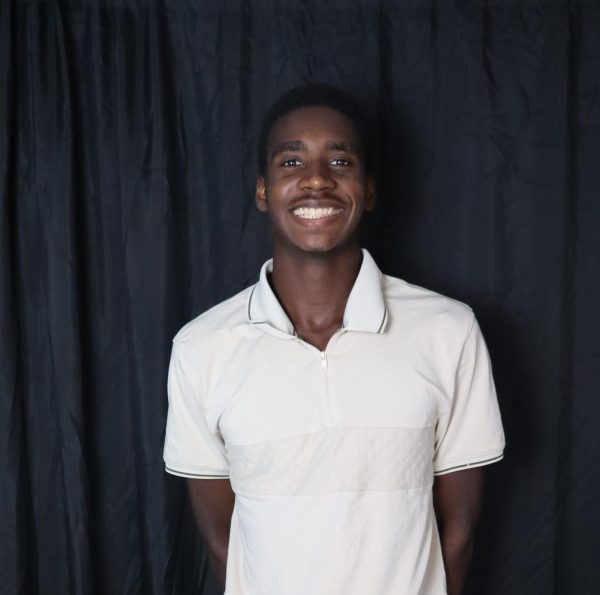
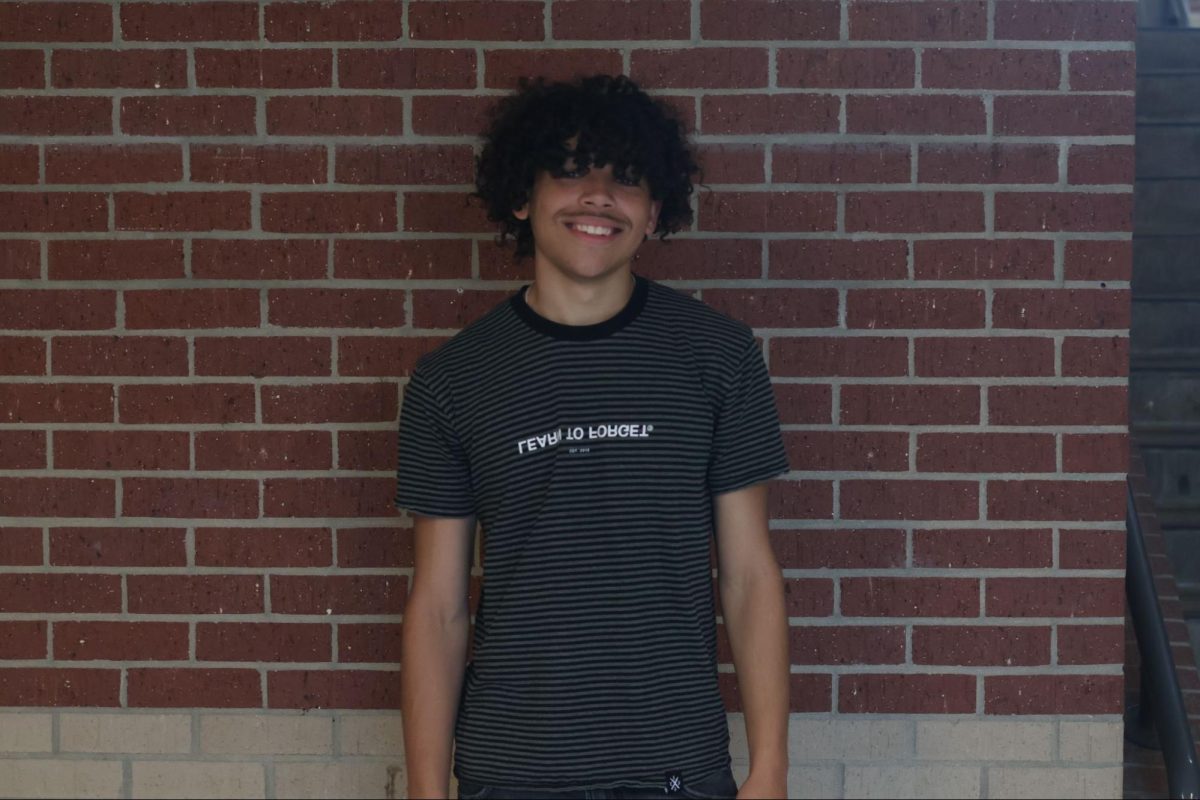
Runners, to your mark, set, go. Before the firing of the starting gun, or the playing of the first note, sophomore Jaden Brown is competing with himself.
As he sprints down the final straightaway of the track during the 4×4 relay, his thoughts are hazy while attempting to control his breathing and maintain a good pace. What is evident however, is the work Brown has put in to get to this point. Although the pressure might be louder in these stands, other times, Brown might find himself in a quieter competitive atmosphere – sitting in a chair, reading his sheet music during a performance.
Moments of competition are fleeting, but a major part of individual success, and the motivation to continue to pursue a passion stem from years of preparation and a positive support system. From an early age, Brown says he was influenced by his family musically, leading to his eventual participation in choir as well as orchestra. “Back then, my dad, he grew up out of church, so he was always playing a piano, singing, [playing] drums, just playing instruments. My mom was in choir so she was [always] singing.”
Due to this connection, and a requirement to participate in a musical elective in middle school, Brown accidentally found himself joining orchestra. “You’re required to pick an elective, like musical elective. And based off of that, I went to Orchestra because I thought they had piano, but they didn’t. So I chose the instrument, viola. And I liked it because it was in between, not the highest, not the lowest.
While exploring his musical interests, Brown was also a participant in various athletic activities. “In middle school, I did basketball [and] track. At first, my seventh grade year I did hurdles and I transitioned to the 400 meter [dash]. My first meet I ran the 4×4 in district, and then later on, I moved on to long jump in high school, [now in] sophomore year.”
Throughout these experiences, Brown says the struggles involved coaches or teachers not as knowledgeable about teaching. He points to a specific interaction with a coach in track which tested his resolve and commitment to the sport. “At first it was kind of rough because the coach, he didn’t really know how to teach hurdles. So I really struggled to learn the process of it, and I got to a point where I had a really big argument with him. And then I just quit hurdles.”
At the high school level, the increased level of competition means better equipped teachers and an overall greater learning environment.
This is especially evident in orchestra as Brown is a chair leader in a program consistently awarded first division ratings. “In high school, the teacher [is] better, he knows what he’s doing. In middle school, we had this one teacher that quit eighth grade year, so we had to learn a whole new teacher. I like how [Mr. Anderson] is way more experienced. And you know what he’s doing, he’s brought us to state like two times.”
Despite his high ranking role in orchestra, Brown’s willingness to attempt new skills has seen him grow as a leader, helping his teammates who are also trying to get better. In his first year doing long jump, Brown credits his preparation and dedication to improving at the skill. “I caught on pretty easy, I was just running in, and I was telling everybody what to do. Because I was the only one that was like showing up to other practices.”
This attention to detail is an important factor in both track and orchestra, two activities which Brown says differ from a mindset standpoint but have evident parallels, both placing an emphasis on correct posture and form. “For track, you have to really focus about form, and the way you do it, but orchestra is more, you have to stand up straight, and read the notes, learn how to place him in rhythms, [etc.]
The differences lie in the repetition required for track compared to the variety of music composition in orchestra. “For track, it’s just doing one thing over and over. Rather than orchestra, I can get multiple pieces of practice for it. So [I] learn different music. And there’s different [events] for UIL, Portugal Orchestra, we could [end up] playing 3 pieces.”
Brown has continued to grow as a multi-faceted individual also balancing a schedule with multiple Advanced Placement courses, boasting a 3.8 GPA. “I’m in Spanish 2. AP World, Advanced Geometry, Advanced Chem, Orchestra, Track, and Principles of Health Science.”
He places added emphasis on maintaining a high GPA due to the fact that he eventually wants to attend New York University for Dentistry. In preparation for this, he says Principles of Health Science is his most important course. “Obviously I would need it in the future, because I want to become a dentist, oral surgeon. So, in my class, I have to focus on [details], to prepare for that in real life.”
With athletics and academics, as well as extracurriculars, tough decisions have to be made regarding time commitments as schedules overlap. “Well, it’s not that difficult, but sometimes it can be, like last year, I had skipped an overnight Chicago concert to go to one of my games. That was pretty hard.”
However, Brown says that even with the large workload, it doesn’t always feel like work. He says he is passionate about orchestra and track and although his future plans aren’t finalized, he plans to continue participating in both throughout high school.
“I’m trying to see how it is right now. Later on making decisions. Right now, I just want to [do what] makes me happy.”