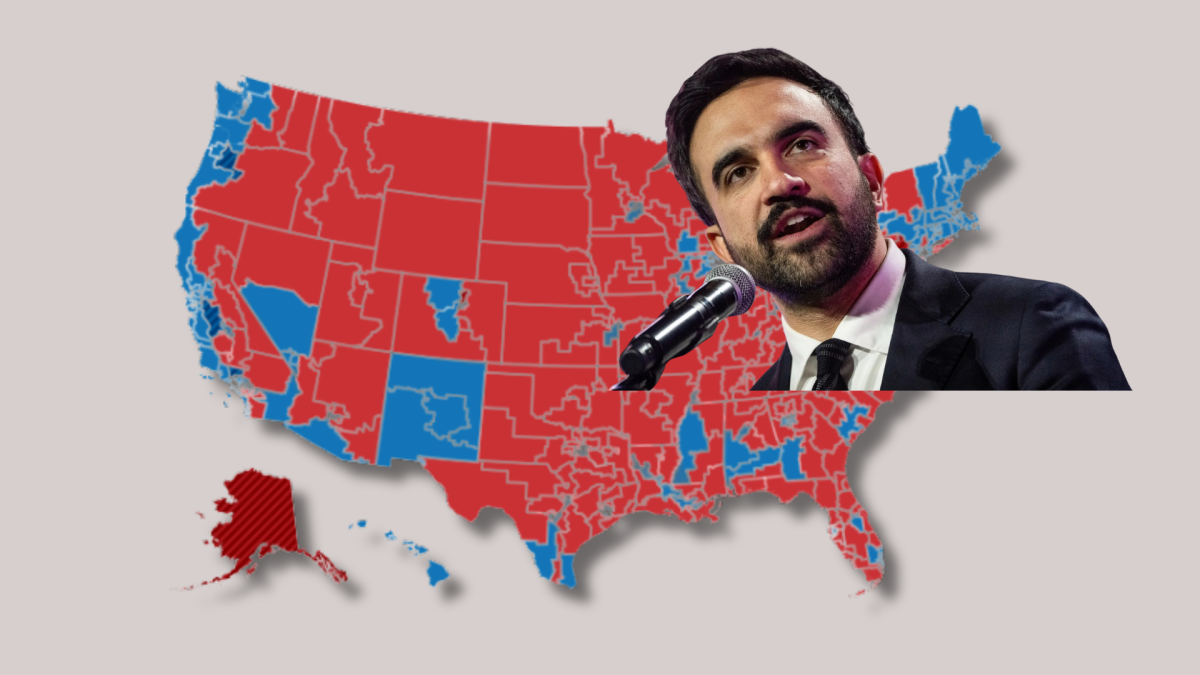
Tuesday, Nov. 4th marked Election Day in states across the country. On the ballot were state gubernatorial races, legislative measures, and redistricting votes. However, the biggest story was the New York City mayoral race, which saw first time candidate Democrat Zohran Mamdani defeat ex-governor Andrew Cuomo, who ran as an independent candidate after losing to Mamdani in the Democratic primary.
The race in New York has intensified over the past couple of weeks, especially after Cuomo received an endorsement from President Donald Trump and super-PAC donations totaling $24 million, making it the biggest PAC in city history. In contrast, Mamdani relied on grassroots support allowing him to win more votes than any New York City mayoral candidate since 1969, as over a million votes were tallied for the Democratic candidate.
According to data from AP News, Mamdani won every borough except for Staten Island, a borough which voted for Trump in the 2024 election. Official splits saw Mamdani win with 50.4% of the vote, but the significant number lies in receiving 65% of first time votes for mayor. In his victory speech, Mamdani once again attempted to separate his vision for New York from Cuomo saying, “Let tonight be the final time I utter his name, as we turn the page on a politics that abandons the many and answers only to the few.”
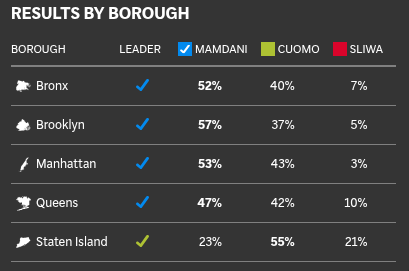
The message, which Mamdani had been building on throughout his campaign, had a major impact on minority voters, as he was polled leading in all 33 of New York’s major Black neighborhoods. The campaign made significant efforts to reach out to a demographic which makes up 22% of New York’s population. This is a remarkable turnaround, considering how in June, Cuomo won 25 of those neighborhoods. Official AP Voter Poll Data also reported that Mamdani was able to win slightly with non-white voters receiving the votes of 6 in 10 Black and Asian voters, around half of Hispanic voters, and splitting white voters with Cuomo.
Mamdani’s victory highlights his impact as a trailblazer, as he became the city’s youngest mayor since 1892 at 34, its first Muslim mayor, and first mayor born in Africa. Mamdani ran on Democratic policies including free childcare and expanded public transportation to help mitigate the homelessness crisis. He also portrayed himself as a candidate for the people, criticizing the wealthy in the city for not paying their fair share of taxes.
Democrats also saw victories in the gubernatorial races in Virginia and New Jersey as Democratic Rep. Abigail Spanberger defeated Republican Lt. Gov. Winsome Earle-Sears and Democratic Rep. Mikie Sherrill defeated former Republican legislator Jack Ciattarelli respectively. The results were a step in the right direction for Democrats, who regained traction in blue states where Trump was able to gain a share of votes in the most recent presidential election.
During most midterm and non-presidential election cycles, state gubernatorial races often have the opposite party winning elections because of dissatisfaction with the government at the national level.
Democratic National Committee Chairman Ken Martin affirmed this notion saying, “The important thing to remember is midterm elections are not a referendum on a party that’s not in power,” Martin said. “So our numbers really don’t matter here. Donald Trump is at an all-time low in terms of his favorability and his approval numbers… the Republican Party is as well.
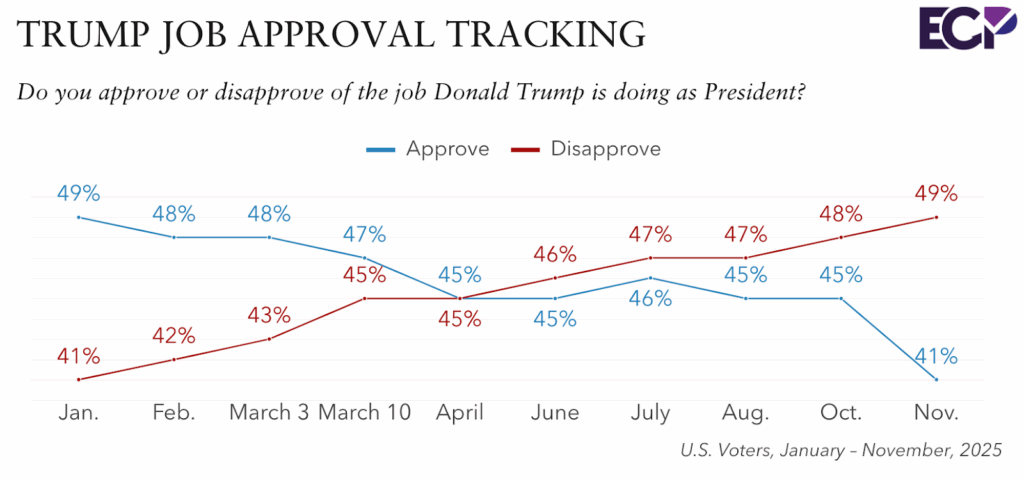
The biggest issues for voters in this election cycle included the economy and discontent with the current presidential administration. Despite this, the Democratic party is viewed by voters as more unpopular than it’s ever been, but pales against the contrast of President Trump’’s less popular policies. This was seen during the No Kings Protests throughout the country last month, which saw over 7 million Americans protest the seemingly gradual slip of the country into a dictatorship.
This was one of the reasons California voters voted yes on Proposition 50, allowing state legislators to redistrict before the 2026 midterm elections, in an effort to counter Republican gerrymandering efforts in states including Texas, Missouri, and North Carolina. The proposition passed with nearly 64% of the vote and is a key victory for California Governor Gavin Newsom, who has floated the idea of running for president in 2028. The measure could help Democrats win five more seats in the U.S. House and highlights Texas specifically in an effort to counter the five seats gained by Republicans due to congressional boundaries redrawn by Texas Governor Greg Abbott.
In a visit to Houston on Saturday, Newsom thanked voters during a victory speech for Prop 50. “You woke us up.” Newsom said, referring to Texas Democrats’ resistance to redistricting. “You didn’t just have your back here, you had our back in the state of California.”
Texas specifically saw one of the biggest cycles for amendments to the state constitution as voters saw 17 proposed amendments on the ballot. The issues covered included efforts to change taxes, education, infrastructure and more.
During a non-midterm or non-presidential election cycle, voter turnout is usually lower than what you would typically see during a major election. However, the appearance of many controversial items on the ballot led to a boosted turnout in Austin and San Antonio. Tuesday saw more than 2.9 million Texans cast their ballot according to the Texas Secretary of State’s Office. In 2023, the last cycle which saw constitutional amendments on the ballot, turnout was significantly lower at 2.5 million Texans.
Although increased turnout for a nonelection year is positive, 18.5 million Americans are registered to vote in Texas meaning just under 16% of registered voters participated. “Few people vote in these elections. It generally isn’t on most people’s radar,” said Brandon Rottinghaus, a political scientist at the University of Houston.
“Most of the time, you have partisanship that tends to juice up turnout,” Rottinghaus said. “In the absence of there being a clear Republican or Democratic outcome here, people tend to not vote in significant numbers.”
Following the theme of redistricting efforts, Democrats in Mississippi were able to effectively deny the possibility of a Republican supermajority after flipping two seats in the Senate and one in the House. A federal court ordered congressional boundaries to be redrawn in 14 districts after findings that Black voters were discriminated against in 2022 midterms.
As these efforts continue, another factor could come into play in time for the 2026 midterms as the Supreme Court is reviewing a case that could reshape how congressional districts are redrawn.