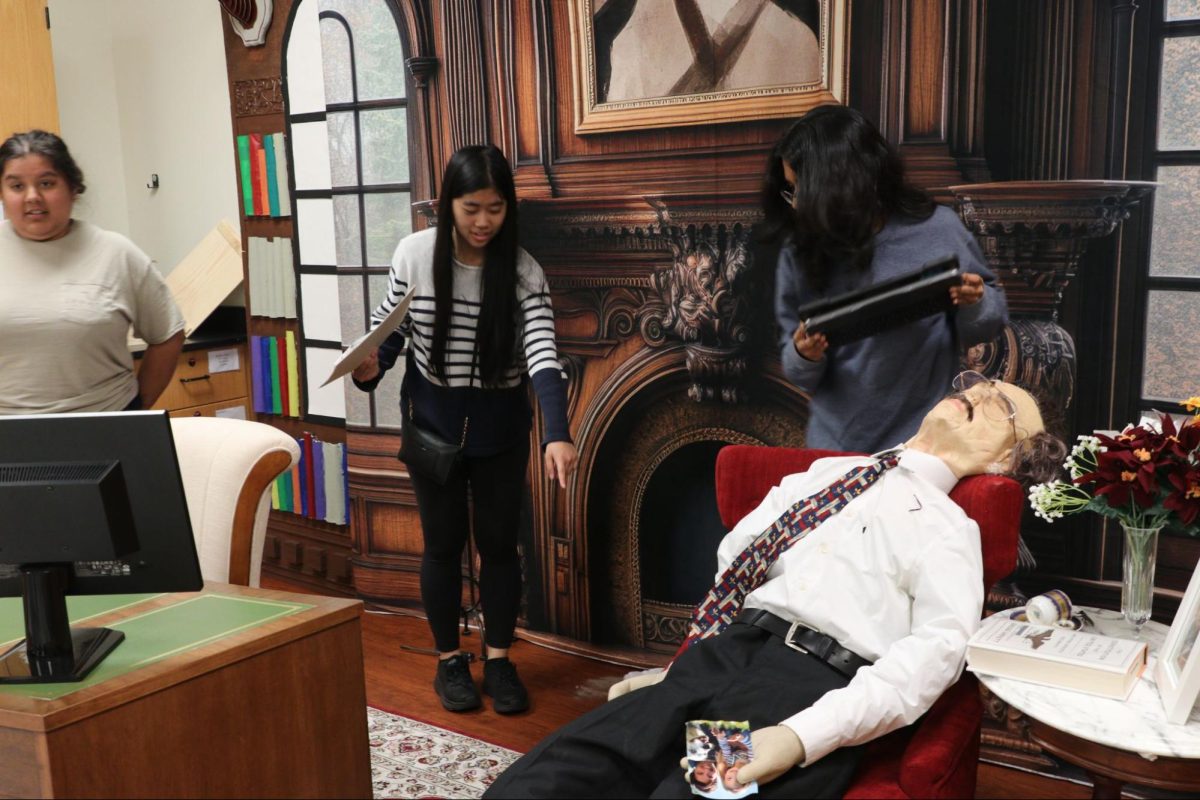

The crime scene in Forensic Science Teacher Carol Seng’s classroom is not real, but allows students to feel close to one. With yellow tape, scattered evidence, and a lifelike mannequin “victim”, Seng transforms her class into a full investigation experience.
Over the past few weeks, students have practiced securing a crime scene, sketching, photographing, hearing from guest speakers in the legal field and collecting evidence as they piece together clues for their mock investigation.
“The guest speakers gave students a real-world perspective,” Seng said. “They showed how evidence doesn’t stop at the scene, it continues all the way into the courtroom.”
As the project continues, students moved on to sketching rough diagrams before completing their final scaled versions in early October.
“Sketching really helped me slow down and look at every detail,” senior Rachel Abraham said. “You realize how much you can miss if you don’t pay attention to where each piece of evidence is placed.”
After completing their sketches, the class transitioned to collecting and labeling evidence, applying the chain of custody process to maintain proper documentation. Seng said this stage emphasizes accuracy and teamwork to mirror what real investigators do in the field.
“Having to tag and log every single item made me realise how easy it is to mess up if I stopped paying attention,” Abraham said. “You have to communicate constantly to make sure every piece of evidence is accounted for and nothing gets lost in the process.”
With the initial investigation complete, the class will begin a hair analysis lab, Oct. 30–31 and Nov. 3–4, where students will compare microscopic hair samples to learn how small pieces of evidence can help connect suspects to a scene.