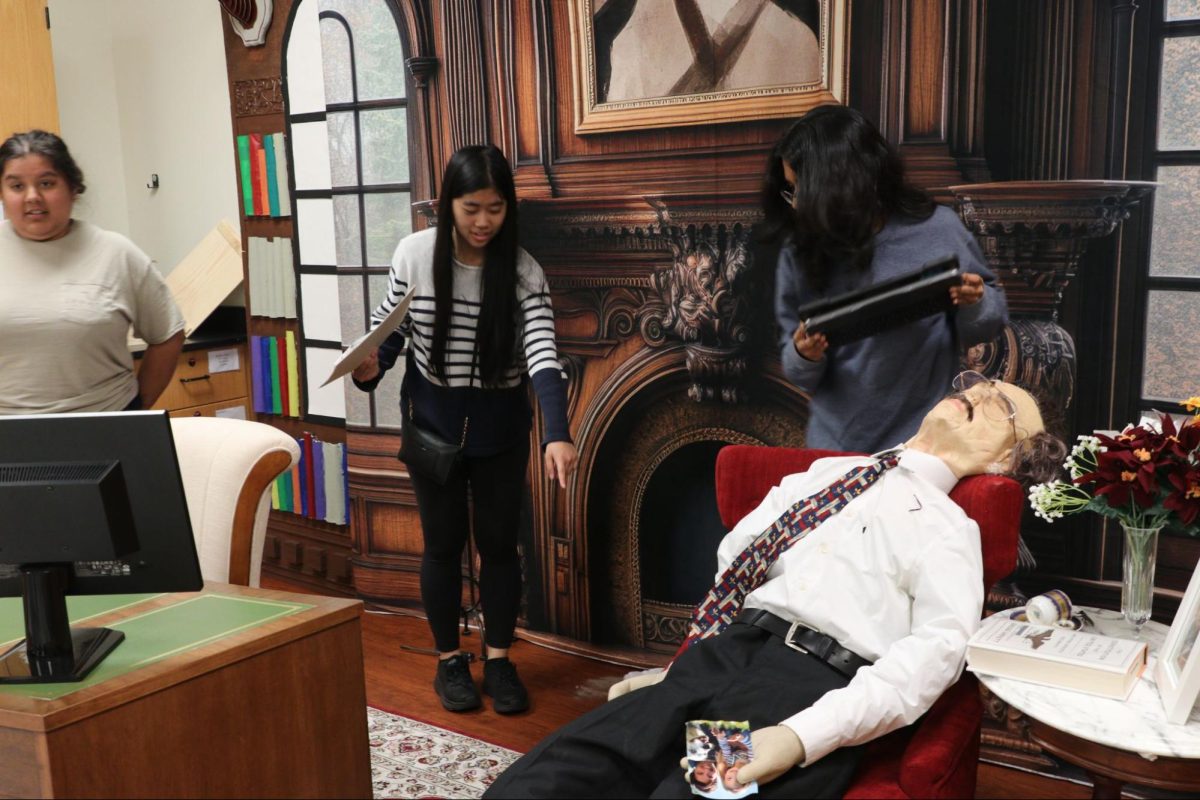

Scattered strands on the microscope trays didn’t look like much at first, just hair, threads and tiny plant pieces barely visible to the naked eye. But for Forensic Science teacher Carol Seng’s classroom, those fibers became crucial clues in the unfolding mock investigation of Judge Holmes’ mysterious death.
In the latest phase of the crime scene project, students shifted from documenting and collecting evidence to analyzing what they gathered. The fiber lab introduced them to tasks such as examining microscopic hair, plant material and fabric to determine how each piece may connect to the victim, suspects and the crime scene itself. Through side by side comparisons, students learned to distinguish natural and synthetic fibers, identify weave patterns and recognize how even a single strand of hair can help reconstruct what happened in the final moments of a case. Using both compound and dissecting microscopes, they explored how investigators piece together class evidence, material that can not be found on a single person but can strengthen or redirect an investigation when combined with other clues.
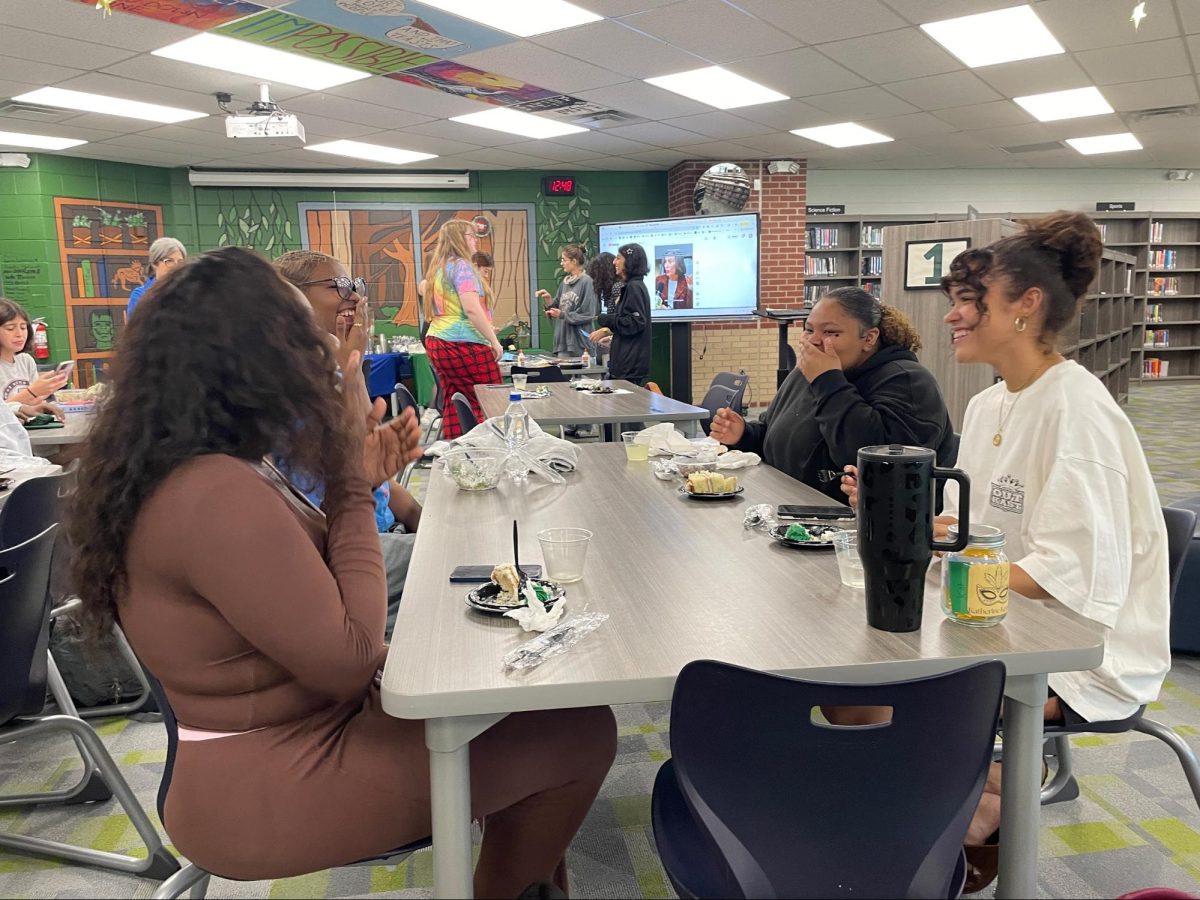
“It helped show us what a crime scene entails, and it helped make it more realistic,” junior Tuscany Morthole said. “Letting us look at different hairs and our own helped us see what they have to do in real life, to see who or even to identify a criminal.”
Before moving to the crime scene samples, students practiced identifying the differences between hair, plant fibers and fabrics.
“We practiced looking at different types of material to learn the differences and more accurately completed our lab,” Morthole said. “[The fibers] felt harder than hair, because to me at least hair is interesting to look at and have the same shape or looks to identify while fibers don’t.”
Once students understood how fibers appear under magnification, they compared their known samples to the unknown materials pulled from Judge Holmes’ office and clothing. Seng designed the activity so students could see how real forensic labs analyze class evidence step by step.
“Unknown fibers were found at the Judge Holmes crime scene and we want to know where they came from and if possible who it belongs to,” Seng said. “We are not expecting to find an exact match but narrow down our search which is class evidence.”
To compare the samples, students used compound microscopes for hair samples and dissecting microscopes for thicker fabric pieces.
“We used a compound, traditional, microscope,” Seng said. “And for the weave patterns, fabric is thicker and prevents light from shining straight through it, [we] used a dissecting microscope.”
The fibers collected from the scene included several pieces including; long blond human hair matching Eliza Holmes, white dog hair consistent with the family Samoyed, a plant fiber from a hemlock bud found in a teacup and a synthetic black-brown strand matching fabric owned by Dr. Marcus Bellamy.
“The long blond human hair matches our person of interest Eliza Holmes, daughter of the deceased,” Seng said. “This will be further evaluated for DNA later in the school year. The dog hair is a visual match to Eliza Holmes’ dog which is a Samoyed breed. The plant-like fiber that was found inside of the tea cup was identified as being part of a bud from a hemlock plant. The black/brown fiber was a piece of synthetic fabric which matched a piece of fabric owned by Dr. Marcus Bellamy.”
As the samples were analyzed, students found themselves asking new questions about how each fiber was in the judge’s chambers.

“The students should be asking why [there is] a piece of fabric that matches something from Dr. Bellamy on Judge Holmes’ shirt just above a bullet hole, and how did hemlock get inside a Judge’s chambers,” Seng said. “Students should start thinking about [what] was worse for the judge, hemlock or a bullet. And several started asking how hemlock gets in the glass.”
Throughout the process, Seng emphasized that fiber evidence rarely stands alone. Instead, it supports a broader narrative when combined with multiple forms of documentation and analysis.
“Fibers are considered class evidence,” Seng said. “We can’t say this fiber came from this exact piece of fabric, we can only say it is the same type of fiber. If only one person of interest has that particular piece of fabric then it just makes the case a little stronger. You would not get a conviction off a fiber if that was the only piece of evidence you had but if all the evidence points in one direction it just makes the case stronger. It can also give investigators a new avenue to ask questions if not much is known about the case.”
For students like Morthole, the experience highlighted how seemingly small details can shift the direction of a case.
“I think the fibers are reliable since they can be used to solve if a body got moved, or [if they are] in a certain place at a certain point,” Morthole said. “Which helps them figure out what happened and how they died.”
Students will next move onto the impressions part of their crime scene lab to gain knowledge and watch the mock trial unfold.