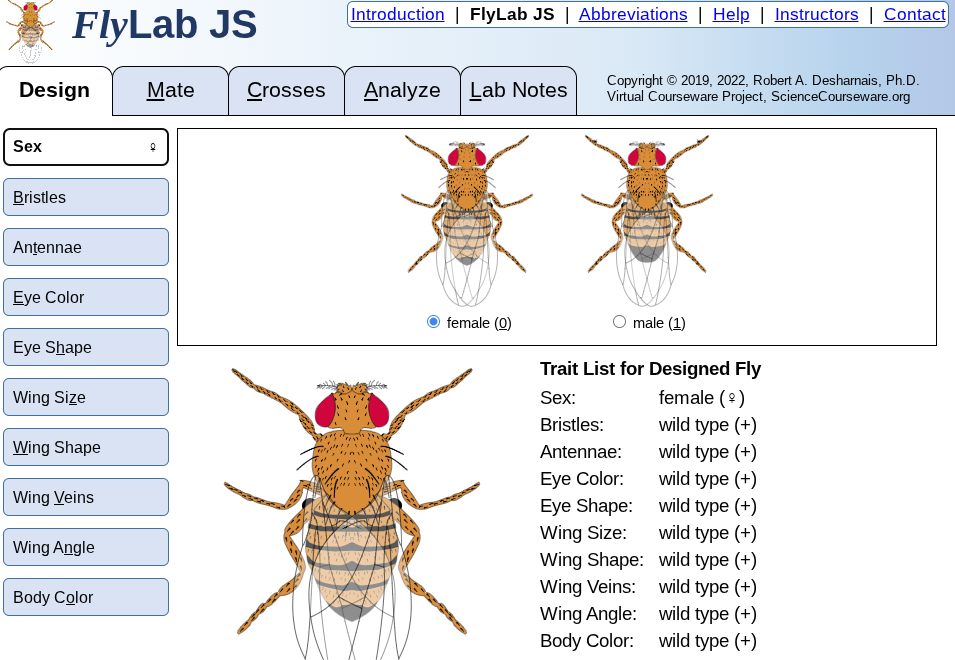
Instead of simply filling in Punnett squares on paper, biology students are stepping into the role of real geneticists through a virtual fruit fly lab designed to test patterns of inheritance.
As part of their heredity unit, students are using a fruit fly simulation to investigate how traits are passed from one generation to the next. The lab goes beyond textbook examples and allows students to analyze real data, identify patterns and draw evidence-based conclusions about dominance, sex linkage and gene linkage.
“The goal of the genetics lab was for students to investigate how traits are inherited by analyzing genetic crosses,” biology teacher Miranda Katz said. “Instead of only solving Punnett square problems, students used data to determine patterns like dominance, sex linkage, and gene linkage. The focus was on thinking like scientists and using evidence to draw conclusions.”
Fruit flies have long been used in scientific research because of their fast reproduction rate and clearly visible traits. According to Katz, students are working with a classic model organism that has helped scientists understand inheritance for decades.
“Fruit flies are ideal for genetics because they reproduce quickly and have clear visible traits,” Katz said. “Scientists have used fruit flies for many years to study inheritance, so students are working with a classic research organism. The virtual simulation lets students collect large amounts of data in a short time, and many college genetics labs use real fruit flies, so this activity helps prepare students for future laboratory experiences.”
During the lab, students first determine whether traits are dominant or recessive and whether they are autosomal or sex-linked. They then perform additional crosses to test whether genes are linked, requiring careful analysis of offspring ratios.
“At first it was confusing trying to figure out what the numbers meant, but once we started seeing patterns, it felt like solving a mystery,” junior Tuscany Morthole said. “It was cool to design our own experiments and choose which genes to test instead of just being told the answer.”
Katz said the lab also strengthens important scientific skills beyond content knowledge.
“Students practiced data analysis, problem solving, and scientific reasoning,” Katz said. “They had to recognize patterns in numbers and support their conclusions with evidence.”
While real fruit flies are often used in college laboratories, practical limitations such as time, space, and maintaining live cultures make that difficult in a high school setting. The virtual format allows students to complete multiple genetic crosses and analyze large data sets within a class period.
“While I would love to use real fruit flies,” Katz said. “There are practical limitations such as time, space, and the need to maintain live cultures. The virtual lab allows students to complete many crosses and analyze large data sets in a short period of time. It still gives them an authentic experience investigating inheritance patterns while fitting within the structure of a school schedule”.
By the end of the lab, students are not just memorizing terms like dominant and recessive, they are applying them, testing them and proving them with evidence.