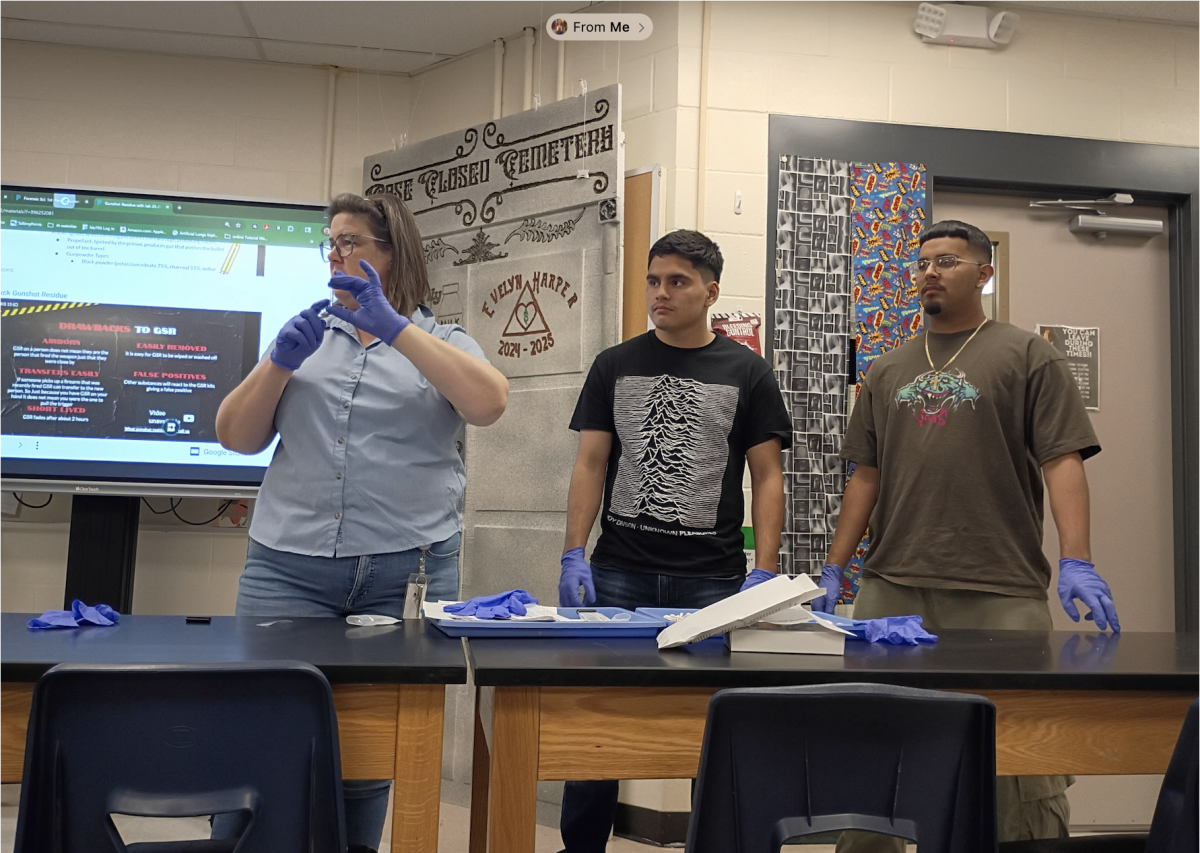
Students hunch over lab tables, turning small pieces of metal under the light, looking for details that don’t stand out at first glance. A slight groove, a faint marking, a pattern that only starts to make sense after a second look. In one of the final labs of the year-long crime scene case project, forensics students are analyzing ballistics, where the smallest details can shift the entire story.
As the case nears its end, this lab asks students to move past observation and into analysis. Ballistics ties together everything from bullet structure to firearm markings and gunshot residue, pushing students to support their conclusions with evidence instead of assumptions. It is one of the last steps before they review the full case, deciding what can actually be proven and what cannot.
“The bullet first needs to be able to fit into the Firearm,” forensics teacher Carol Seng said. “Then once it has been fired the firearm will leave marks on the bullet as it travels down the barrel of the gun. Due to the condition of the firearm, blemishes in the metal caused by wear and tear will be transferred to the moving projectile and those marks can be matched up.”
While the lab focuses on technical skills, it also challenges what students think they already know. Misconceptions, especially from movies and TV, come up quickly when discussing gunshot residue and how reliable it actually is in real investigations.
“A common Misconception is that GSR (gunshot residue) stays a long time, and that whoever has GSR on them is the shooter,” Seng said. “GSR only lasts about two hours and it is easily transferable to other people in close proximity.”
As students work through the lab, they are not just learning how evidence works, but also how it can be misinterpreted. Seng said one of the goals of the unit is to make sure students understand that no single piece of evidence stands alone, especially something like gunshot residue.
“To clear up misconceptions about GSR, it is not the “smoking gun” of a case,” Seng said. “[It’s] something that is more useful to back up existing evidence and to find avenues to question more people.”
Students say the hands-on aspect of the lab makes those ideas easier to understand. Instead of just hearing about evidence, they are working directly with it, identifying features and learning how each detail connects back to a firearm and the larger case.
“We got to learn the different components of a bullet,” junior Tuscany Morthole said. “I thought it was interesting because I didn’t realize that a bullet also had a cartridge. In the bullet there are lands and grooves. You can also see what direction of twist it did which also helps us identify what type of gun used.”
As the lab continues, students also examine cartridge casings, rotating them between their fingers to study the base, where small imprints and materials can point back to a specific firearm.
“We learned how to identify the bottom of the bullet shell,” Morthole said. “I learned there are different types of metal on them. Such as brass, nickel, steel. There can be cravings on the bottom that are manufactured on it, to help identify what gun it was used on.”
With the project coming to a close, students are not just finishing labs, but reflecting on how each piece fits together and how much they have learned through the process.
“I really enjoyed the lab and the whole project as a whole,” Morthole said. “Seng has done a great job at making us involved and invested throughout the year.”